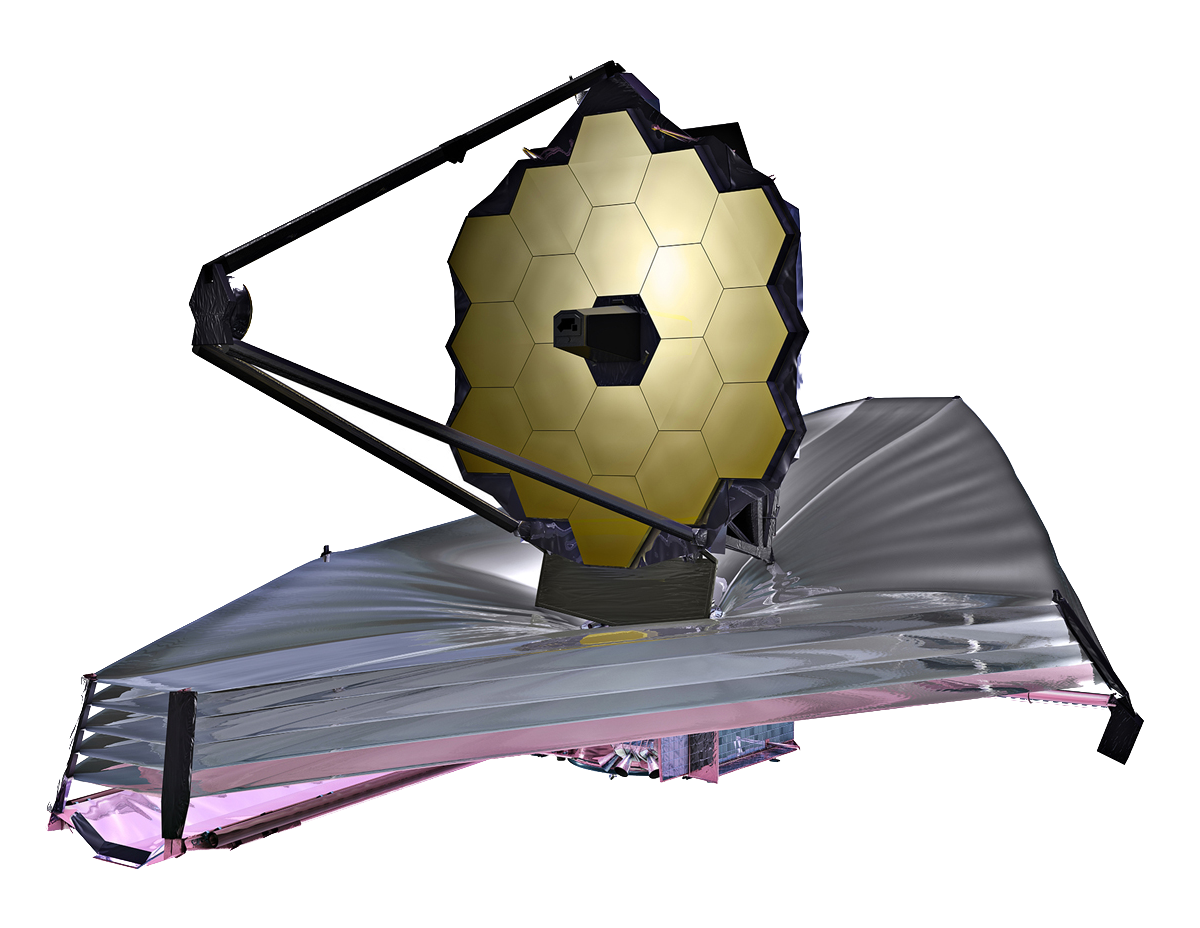
welcome to first galaxies
exploring the origins of galaxies in the early universe
exploring the origins of galaxies in the early universe
Read Garth Illingworth's reports around the December 25, 2021 JWST Launch. These posts where distributed as updates to the astronomy community.
More
Prior to September 10, 2002, the JWST was known as the Next Generation Space Telescope (NGST). JWST: The Early Years is a site detailing the early days of the James Webb Space Telescope
MoreLike everything else, JWST I&T (Integration and Test) activities at Northrop Grumman Space Park in Redondo Beach near LAX have been impacted by COVID-19. Most all of the large crew of NASA folks from GSFC who were at Northrop working with the Northrop team for the JWST I&T activities are back home in the Maryland/DC/Virginia area. However, some work is still continuing in the huge clean room at Northrop, albeit at a slower pace with stringent precautionary measures to ensure minimal risk to the Northrop I&T workforce. The priority in the COVID-19 era has been to ensure that all the people involved are safe, and feel safe in what they do, and to not risk the observatory in any way. The JWST Observatory is safe in the clean room.
The Observatory (since it is now a complete Observatory) is currently undergoing a variety of deployment checks and tests that are being done to verify everything works before it is taken into a separate clean-room area where it will be shaken (not stirred) in each of three-axes (one at a time) on a huge vibration fixture, as well as being subjected to very high levels of acoustic noise. These “environmental tests” are done in the launch folded-up configuration and are meant to mimic what the observatory will feel when it is launched atop the Ariane 5 rocket in 2021. The subsequent post-environmental deployment test of the wings is planned to be done one at a time. Then there will be a final fold-up of the observatory and shipping via the Panama Canal to French Guiana for pre-launch checkout and preparations — and then launch on the Ariane 5.
While work continues for now, these pre-environmental deployment checks will need to further slow down once we get to the more complex ones that require the full NASA and Northrop crew. They will only be carried out when that full NASA-Northrop team is available in-person at Northrop. The acoustics and vibration “environmental tests” are thus on hold for a period TBD until all the pre-environmental checks and tests can be completed.
As I highlighted in my update to you late last year, progress on JWST has been really good (see the item below re "Major Milestones”). This really good progress continued through into March until the COVID-19 impacts hit.
A major milestone was achieved in early March with the deployment of the two wings from their launch-stowed positions to make the full mirror. There are a couple of images attached and a great video in this media release:
This is the last time that the mirror will be in its full configuration with both wings deployed. The subsequent post-environmental deployment test of is expected to be one at a time. The secondary was unfolded for the last time a year ago. The next time that the secondary is deployed and the wings are deployed to give our full telescope will be in orbit!
If you are interested in more aspects of JWST, and some great images and videos, this is a good place to look:
https://www.nasa.gov/mission_pages/webb/main/index.htmlKeep safe and best wishes for dealing with the COVID-19 challenges.
Garth Illingworth


Ps — click on these to get the full resolution images.
In October JWST passed a major milestone (or, to be more accurate, two major milestones). This is an exciting and very rewarding time for all those who have worked so hard on the JWST Observatory. The full testing is by no means done, but these accomplishments are truly major steps forward towards the launch of JWST in 2021.
The first was the completion of the integration of the optical telescope assembly and instruments (OTIS) with the sunshield and the spacecraft element (SCE). The mechanical connection was first made in September, when OTIS was lowered (extremely carefully) onto the SCE via a series of small and accurate moves in three-dimensions to ensure that all the complex hardware in the central core region came together without any bumping or scraping! This mechanical integration was a crucial step, but the integration process was only deemed to be completed when all the electrical harness connections between OTIS and the spacecraft were checked out and the alignment checks were made. This occurred in October. It all looked good. So JWST is now an Observatory! This is an enormously important step and a crucial one as JWST progresses on its way towards launch.
The second major step was to deploy and tension the sunshield. As is visually obvious, the sunshield is a large and immensely complicated structure, with multiple steps in its deployment. These included the raising of OTIS on its deployable tower (just as will be done in orbit, though here on the ground in one-g with a little assist from a precision crane with very carefully balanced forces); the roll-back of the cover that protects the sunshield during shipping and launch when the sunshield is folded up on the long arms that support it; the extension of the telescoping mid-booms that pull the cover out; and then to the separation and tensioning of the five thin layers of Kapton film with a very complex and carefully orchestrated series of cable motions. And this has to all be done in one-g with support as needed to ensure that the mechanisms are not stressed and that the deployment is faithful to the zero-g situation in space when we do the last and most important deployment! While this is going on we have to ensure that the whole observatory is supported in case of the (unlikely) event of an earthquake. The image below shows the Observatory with the fully tensioned sunshield in the large clean room at Northrop Grumman Redondo Beach from a NASA media release in late October.
To say this is a milestone is to understate the enormously complex development process and the level of cross-checking and testing that has enabled JWST to reach this point. It has taken a remarkable team of incredibly capable people spread across NASA, Northrop Grumman, the science community, and a large suite of contractors with their unique technologies, to reach this point. JWST has been at the cutting edge technologically, and has demanded the very best from those managing and working on such a complex program. It is a testament to all those involved to have JWST reach this point.
JWST has had its challenges and disappointments, with a tough period of reviews, both internally and externally, over the last couple of years when problems arose, but no mission of this complexity and technological reach will ever flow smoothly. Nor should we expect it to do so. If it is straightforward and easy, we haven’t been ambitious enough, and the science returns will not be as dramatic and far-reaching as they could have been.
We are by no means at the conclusion of the testing of JWST. The whole Observatory needs to undergo vibration and acoustic tests to demonstrate readiness for the noisy, rough ride into space. Before this series of tests can start a number of fixes need to be completed, and the delicate sunshield must be (very carefully) folded up, so that the Observatory is in its compact launch configuration. When those noise and shake tests are done, the sunshield will be deployed and the Observatory checked to ensure that everything still works OK. The sunshield is then folded up again and JWST is put into its special shipping container for transfer by boat to the Ariane launch site at Kourou in French Guiana. Further checking will be done at Kourou and the final preparations performed for launch.
There will surely be bumps in the road ahead before JWST ships to the launch site. We can be proud of the accomplishments to date, but the path forward requires continual focus on “mission success”, i.e., ensuring that JWST realizes its science capabilities at L2 following its launch and commissioning, while also being cognizant of the schedule and budget responsibilities that we have. As JWST progresses towards launch the science potential of this amazing observatory remains clear. We are on the threshold of the remarkable science discoveries that will come from a Great Observatory that is dramatically more powerful than Hubble and Spitzer. JWST will take us into a science realm beyond anything that we can now imagine.

This image is from the NASA media release in late October. There is more detailed information in that media release too. And a higher-resolution version of this image.
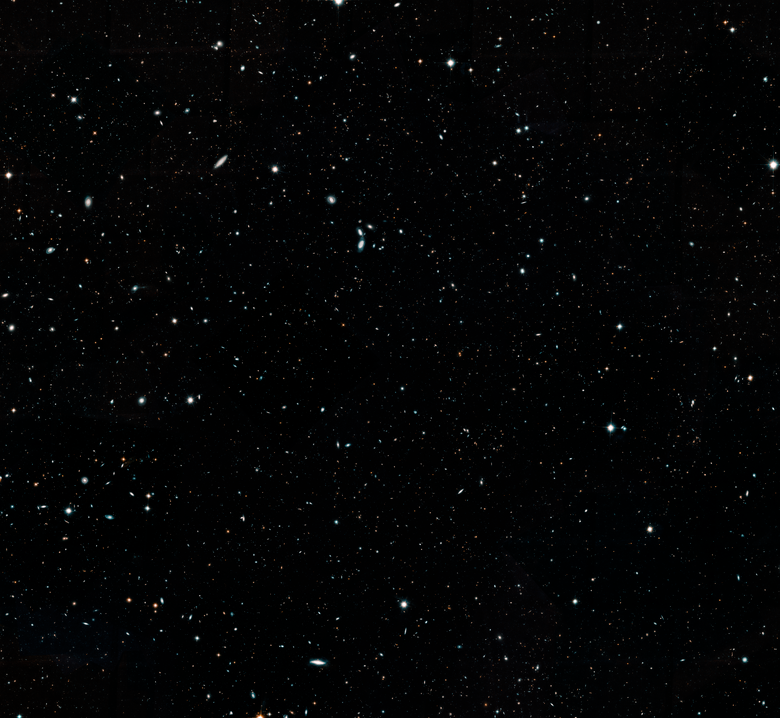
Astronomers have put together the largest and most comprehensive "history book" of galaxies into one single image, using 16 years' worth of observations from NASA's Hubble Space Telescope.
More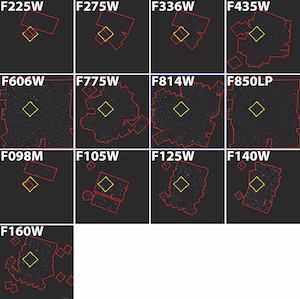
The V2.0 version of the HLF dataset combines over 7500 ACS/WFC and WFC3/IR images covering a 25 x 25 arcminute area plus (smaller) cutouts of four deep areas in the GOODS-South field.
More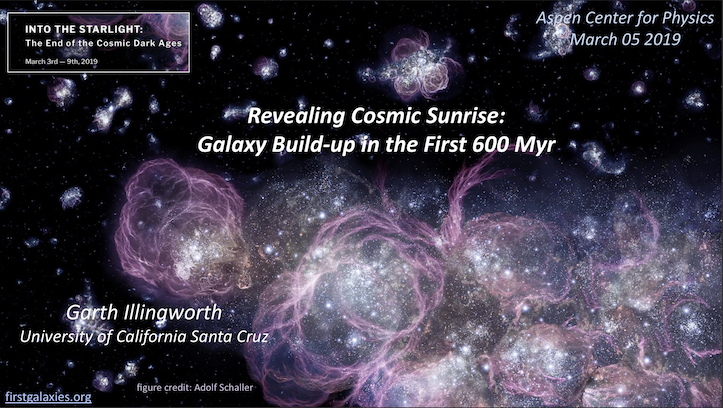
Garth Illingworth's Into The Starlight conference presentation at the Aspen Center for Physics.
More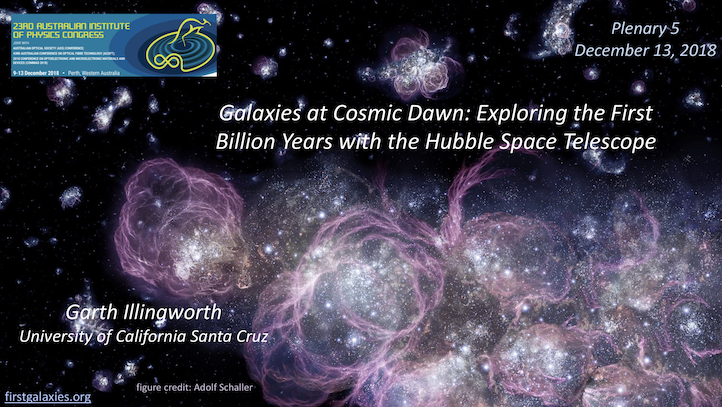
Garth Illingworth's Into The Starlight conference presentation at the 23rd Australian Institute for Physics Congress.
More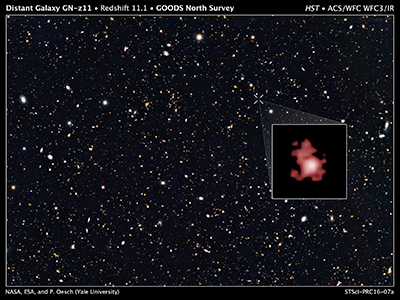
NASA's Hubble Space Telescope is an amazing time machine; by looking back through space, astronomers actually look back through time.
More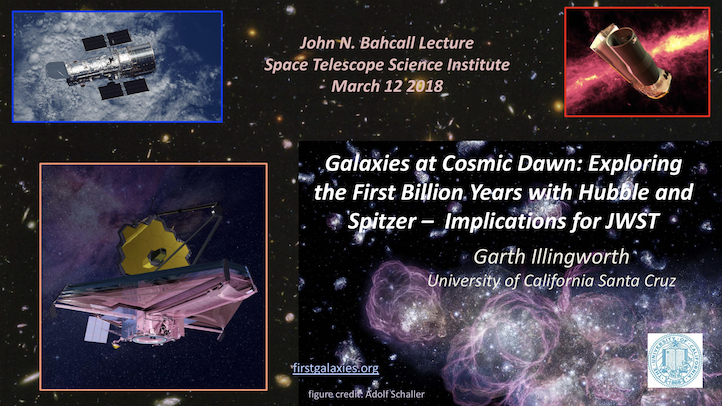
Garth Illingworth's three John Bahcall Lecture Series presentations. Two science talks, one given at the Space Telescope Science Institute and the other at the Goddard Space Flight Center, and one public talk given at the National Air and Space Museum.
More
Prior to September 10, 2002, the JWST was known as the Next Generation Space Telescope (NGST). JWST: The Early Years is a site detailing the early days of the James Webb Space Telescope
More